Off-Plan Construction Delays in Phuket: What a Pause Means and What to Do
Contents
Quick navigation through the main sections of the article
Off-plan construction delays in Phuket happen for a range of reasons, and most pauses on site are scheduled ones: concrete curing, the rainy season, a wait on materials, the renewal of permits. Two things separate that kind of pause from a developer in trouble — whether the developer answers a request for the status of works, and how the payment schedule sits against the stages actually completed. Below: an example of how a build runs on the island, how a stage is evidenced before you release payment, and what to do if the pause drags on.
An example of a construction schedule
A condominium build in Phuket runs through recognisable stages: site preparation and piling, foundations, the concrete frame, walls and facade, mechanical and electrical systems, finishing, landscaping. A villa has fewer stages, and the logic is the same.
Gaps between stages are normal, and some of them are built into the method. Concrete cures over weeks. From May to October Phuket is in its rainy season, and part of the external work slows or stops. The construction permit, issued by the local authority under the Building Control Act B.E. 2522, is renewed periodically, and work can pause while that is processed.
Construction timeline delays of a few months on a 200–300 unit project are ordinary. What separates them from a problem is that the developer names the cause, shows a revised schedule and keeps answering questions.
Payments are tied to stages: how a stage is evidenced before you pay
The payment schedule on an off-plan project is tied to stages of work: a reservation fee, a payment on signing the contract, then instalments as construction stages are passed, with the balance at handover. The stages and their shares differ from project to project, and the exact terms are in the contract.
The logic is that money goes out against work already done. The payment notice comes from the developer citing the stage reached, and it is worth confirming that stage before the transfer.
What you can request from the developer before a payment:
- a photo report with the date of the shoot, tied to the specific works being invoiced;
- a report from the project engineer or technical consultant on the volumes completed;
- a check against the schedule in the contract: which stage is being paid for, which comes next, and when it is expected.
Verifying a stage is straightforward: which stage the invoice is for, and whether it has been completed on site. An invoice for the "walls and windows" stage while recent footage shows empty openings is a reason to sort it out before transferring. A request to accelerate payments ahead of the schedule sits in its own category: we recommend not acting on one without written justification.
Off-plan project due diligence for a buyer comes down to a simple discipline: every payment goes out after the stage it corresponds to has been confirmed.
How progress is tracked on site
Some Phuket developers post photo and video updates on construction progress into the material folders they share with agencies. Not all of them report, and the quality varies: in one case a monthly shoot with captions on the works, in another a few frames with no date.
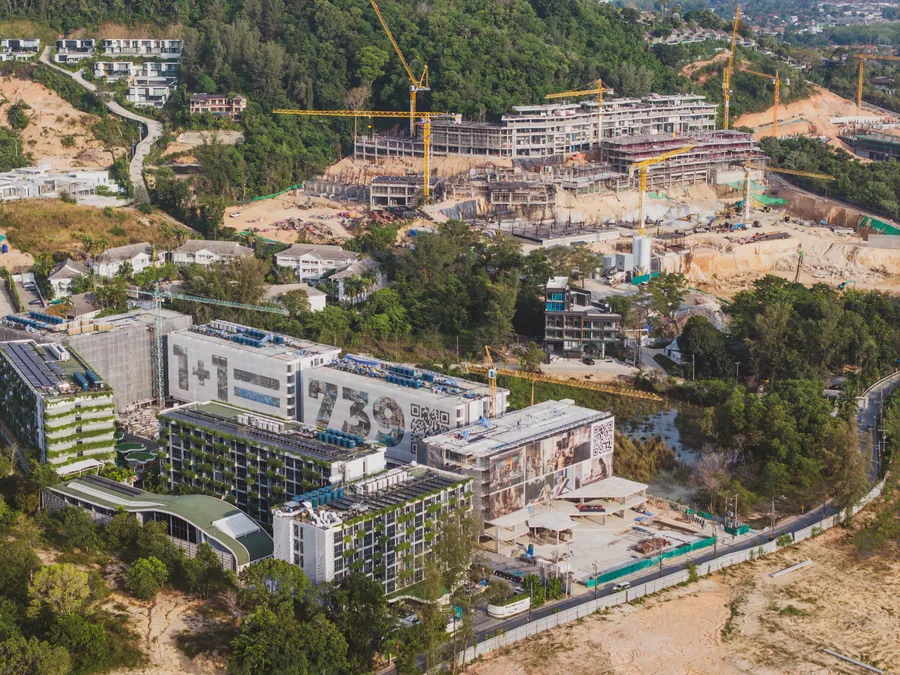
Construction progress monitoring is something Undersun Estate does itself. Agents go out to sites on inspections and film what is happening on the project. Roughly once a month the agency runs drone footage across several projects at once — from the air you see what the ground-level frame misses: the floor work has actually reached, the state of neighbouring blocks, whether there is machinery on site.
Around half of Undersun Estate's international clients buy property in Phuket without ever coming to Thailand. For a buyer in another country, footage from the site stands in for a visit: the agent goes to the project, films the specific block and puts the buyer's questions to the developer.
Which stage to enter a project at
Entering at pre-sale, before open sales start, usually gives the best price in the project and the best choice of units — floor, view, layout. Over two years prices in a successful project can rise by tens of percent, and the buyer who came in first keeps that growth in full.
The trade is time. From reservation to keys at a sales launch takes around two years, and for all of it the buyer depends on the developer carrying the project through to completion. Phuket property development risks are concentrated here.
Hence a simple rule: the earlier the entry stage, the closer the look at the developer and at the project itself. Which buildings the company has already completed, and on what timelines. Who is financing the build. Whether the project holds a valid construction permit and registration under the Condominium Act B.E. 2522. What the contract says about the handover date.
A developer background check in Thailand runs on documents the developer provides: a list of completed projects with actual timelines, the construction permit, the company's registration documents — the certificate of registration and the affidavit from the Department of Business Development. What to request and what to look for in those papers is covered separately — how to check a Phuket developer before signing.
Undersun Estate reviews title, developer and contract documents as part of buyer support, working from papers requested from the developer or seller. How far those checks go depends on the property. Full legal due diligence is a separate paid service through partner law firms.
If the pause drags on
A pause becomes a reason to act when work has been still for longer than one reporting cycle and the developer stops explaining what is happening.
What to request at that point:
- a written explanation of the cause of the stoppage and a revised schedule of works;
- confirmation that the construction permit is valid;
- the status of the contract with the main contractor, if work stopped after a change of contractor.
Alongside that, re-read the contract. It should fix the handover date and the consequences of missing it: what the buyer receives on a delay and on what terms they can exit. Where no such clause exists, the question becomes a legal one, and that calls for a licensed Thai lawyer.
Developer financial problems in Phuket show up before the site does. Requests to pay ahead of schedule, work stopped on the company's other projects, refusal to produce permit documentation — each signal has its own possible explanation, together they are a reason to look into it properly.
What a buyer should do
Work stopping on site is a reason to request documents rather than to exit the purchase. The sequence is the same as in normal running: confirmation of the stage before every payment, regular footage of the property, written answers from the developer on timing.
Undersun Estate can take a look at a specific project: what is happening on site now, how the payment schedule in the contract is built, and which questions are worth putting to the developer before the next transfer. Once the project completes, the agency supports registration of the transfer of ownership at the Land Department, including through a power of attorney.
For contractual obligations, tax and inheritance questions, check your own situation with a licensed Thai professional — what is here is the general frame.
Undersun Estate for foreign buyers in Phuket
Undersun Estate is a real estate agency in Phuket. The team has been on the local market since 2020, and under the Undersun Estate name since 2022. It sells new-build and resale property: 500+ developer projects and 200+ resale properties in 15+ districts. The office is in Kathu, open Monday to Friday 10:00–20:00; the team works in English, Russian, Ukrainian and Thai, and the agency holds a 5.0 rating on Google.
Undersun Estate co-founded the Phuket Property Association and is a partner of the Phuket Real Estate Association (P-REA), and is listed among the top five real estate agencies in Phuket by The Thaiger. It charges the buyer no commission and supports the purchase through construction, handover and registration at the Land Department. Around 30% of its transactions are repeat buyers and referrals.
If you are planning a property purchase in Phuket, we would be glad for you to bring it to us. Tell us the budget and the areas you are looking at, and we will send a shortlist of two or three options that fit within a day.
Frequently Asked Questions
What are the risks of buying property in Phuket as a foreigner?
How do I check if a developer in Phuket is legitimate before buying?
What should I do if the handover date slips?

Tatiana Korostyleva
Chief Marketing Officer (CMO)
Tatiana Korostyleva is a co-founder and the Marketing Director of Undersun Estate. With 6 years in digital marketing and over …